
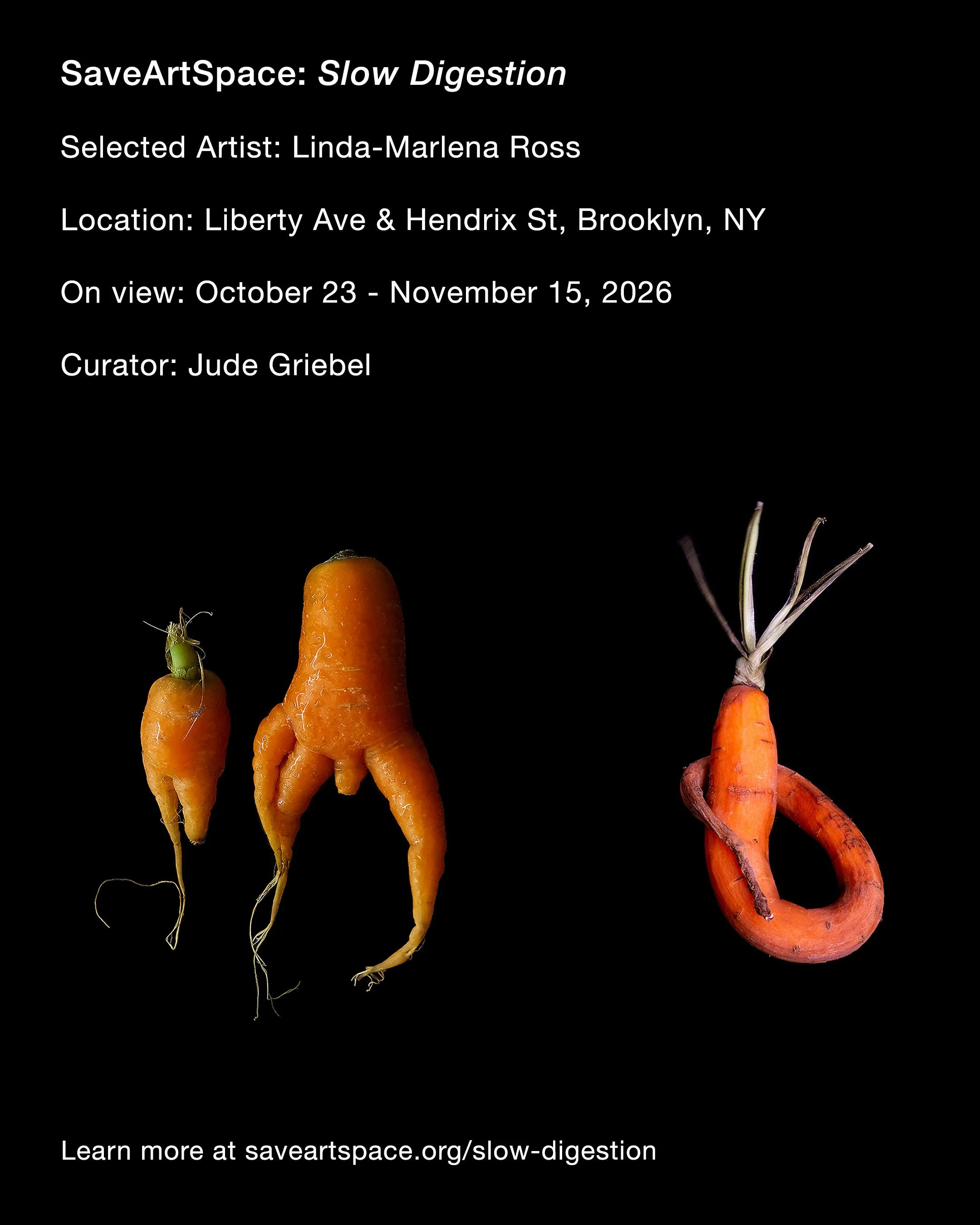
SaveArtSpace is proud to present Slow Digestion, a public art exhibition on billboard ad space in New York, NY, opening October 23, 2026, curated by Jude Griebel.
The Slow Digestion selected artist is Linda-Marlena Ross.
This exhibition presents work on a billboard in New York City, one of the most culturally diverse food cities in the world. The exhibit aims to subvert the billboard as corporate ad space that normalizes the consumption of ultra-processed foods. Proposed artworks might consider foods in terms of our greater entanglement with the world through harvesting, the factory farming of non-human species, unseen labor related to agriculture and products, or food histories that are embedded in communities and private kitchens. Artworks might counter commercial advertising in their consideration of eating as a storied, reflective, personal, and sometimes disquieting, function. These reflective artworks can be slowly digested by the public, while occupying spaces created to promote rapid consumption.
Opening October 23, 2026, SaveArtSpace will launch a public art installation for the selected artwork on billboard ad space in New York, NY. The public art will be on view for at least four weeks.
Selected Artist
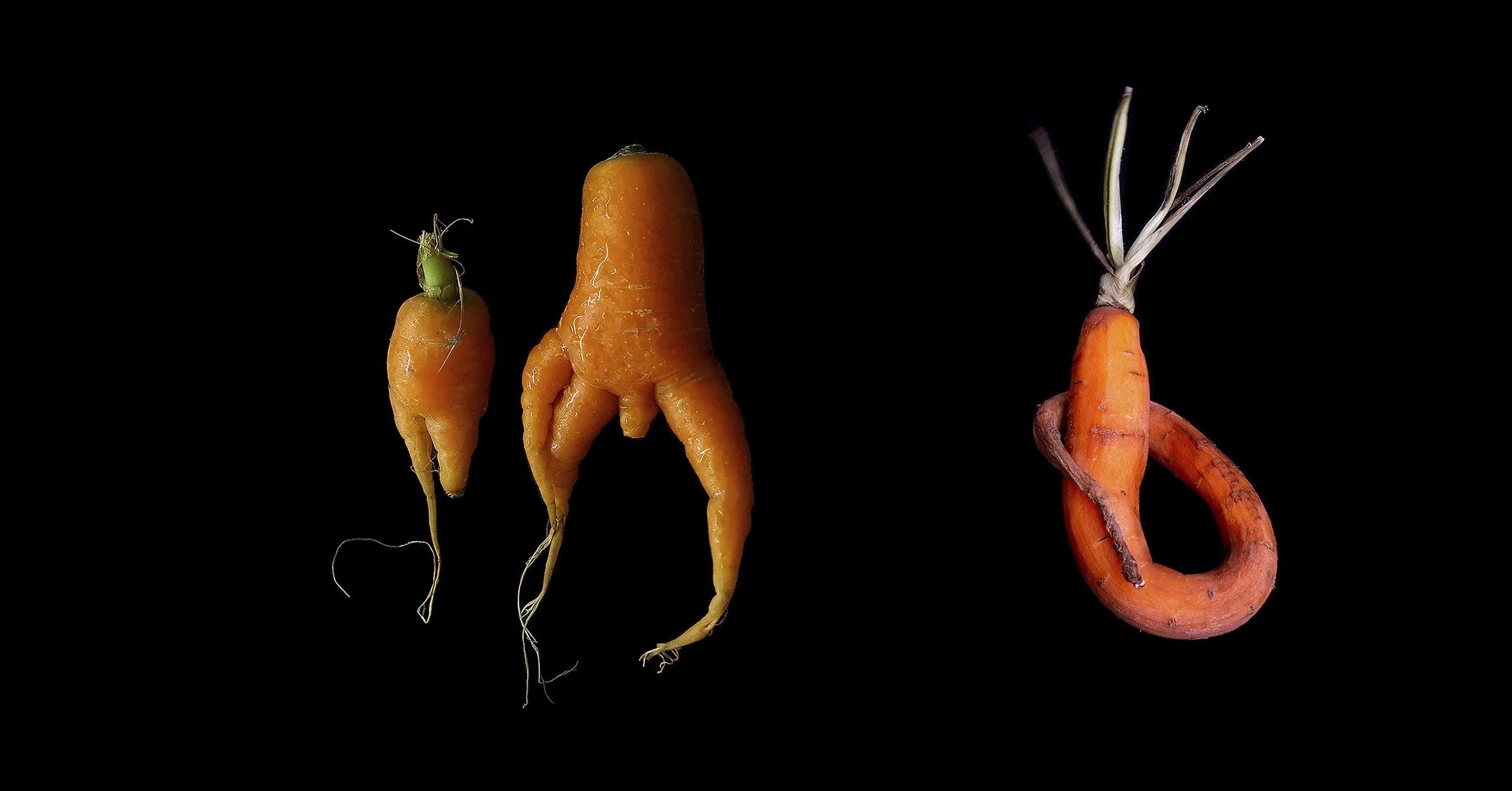
Linda-Marlena Ross
Eat Your Carrots: See Better at Night
Location: Liberty Ave & Hendrix St, Brooklyn, NY
Linda-Marlena Ross, examines the ecological tensions and transformations of fragile environments. Based in Montreal, Quebec, her practice blends photography, painting, and installation to illuminate the complex relationships between humans, biodiversity, and place. She recently documented the shorelines of Newfoundland and Labrador, rainforests in coastal British Columbia, scorched terrain from forest fires in the Okanagan Valley, and boreal moss and lichen systems in Quebec. Her new 'Atlas' of shoreline fragments and torn map remnants become visual equivalents of time: what once was, what has shifted, and what endures. Her images invite questions: What are we not seeing? What is at risk? What binds us to these places? Her work has been exhibited in Canada, Mexico, the U.S.A. and France. Her work is in the permanent collection of the RBC Heritage Centre of the McGill University Health Centre. Her work has been published in the photo journals Prefix Photo (Prefix Institute of Contemporary Art, Toronto) and Ciel Variable, Montreal. She is a recipient of the CALQ Research and Creation Award, Quebec, and has graduate degrees from Concordia University and the University of British Columbia.
Artist Statement:
My work examines the traces of the encounter between Nature and the Built Environment at an intimate scale. Rather than photograph environmental change from the distance of the landscape, I look closely at biological forms, botanical matter, industrial materials, degradation, adaptation and transformation. These become portraits of the consequences of our presence.
Through photography, painting and sculpture, I construct an atlas of a world whose coordinates are becoming unstable. I photograph weeds, roots, vegetables and botanical detritus, the very ordinary biological matter through which we encounter Nature every day. Food is part of this visual vocabulary, connecting urban life to agriculture, soil and the larger ecological systems on which we depend.
Against these organic forms, I introduce cement and industrial materials, the physical language of the Built Environment. Roots encounter concrete. Plants become commodities. Food is separated from the landscape that produced it. Botanical remains become embedded within the materials of urban growth.
These intimate encounters become portraits within the Anthropocene: vegetables become landscapes, roots become rivers, concrete becomes geology, fragments of a planet being cultivated, consumed, urbanized and transformed by human presence.
Connect with Linda-Marlena at @linda_marlena_ross.
Curator
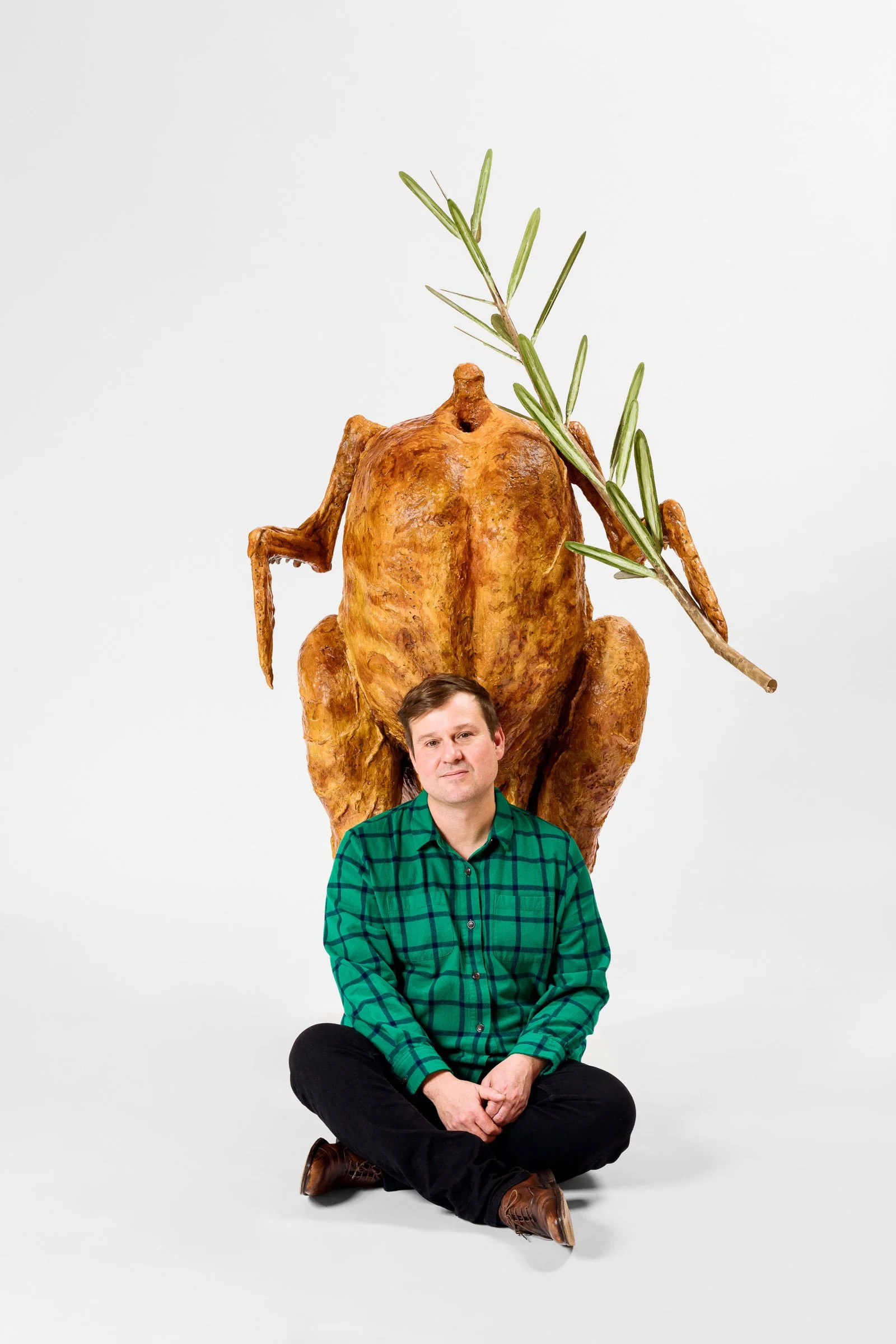
Headshot, Photography by Blaine Campbell
Jude Griebel is a Canadian artist working in New York City. His sculptures probe the intersections between consumerism, ecology, and myth—translating environmental precarity into carefully crafted, allegorical forms. The mechanics of consumerism is a driving theme behind his sculptures, with a specific focus on the factory food system and its implications for land depletion and climate shift. These interests have broadened from his family’s agrarian history on the Canadian prairies to the complexities of global food challenges, ecological strain and interspecific relationships. Griebel is a 2026 Guggenheim Fellow. His work has recently been exhibited at Powerhouse Arts, New York; Massey Klein, New York; Chart, New York; The Rochester Center for Contemporary Art, NY; Galerie Nicolas Robert, Montreal and Leitrim Sculpture Centre, Ireland.
Connect with Jude at @judegriebel.
SaveArtSpace
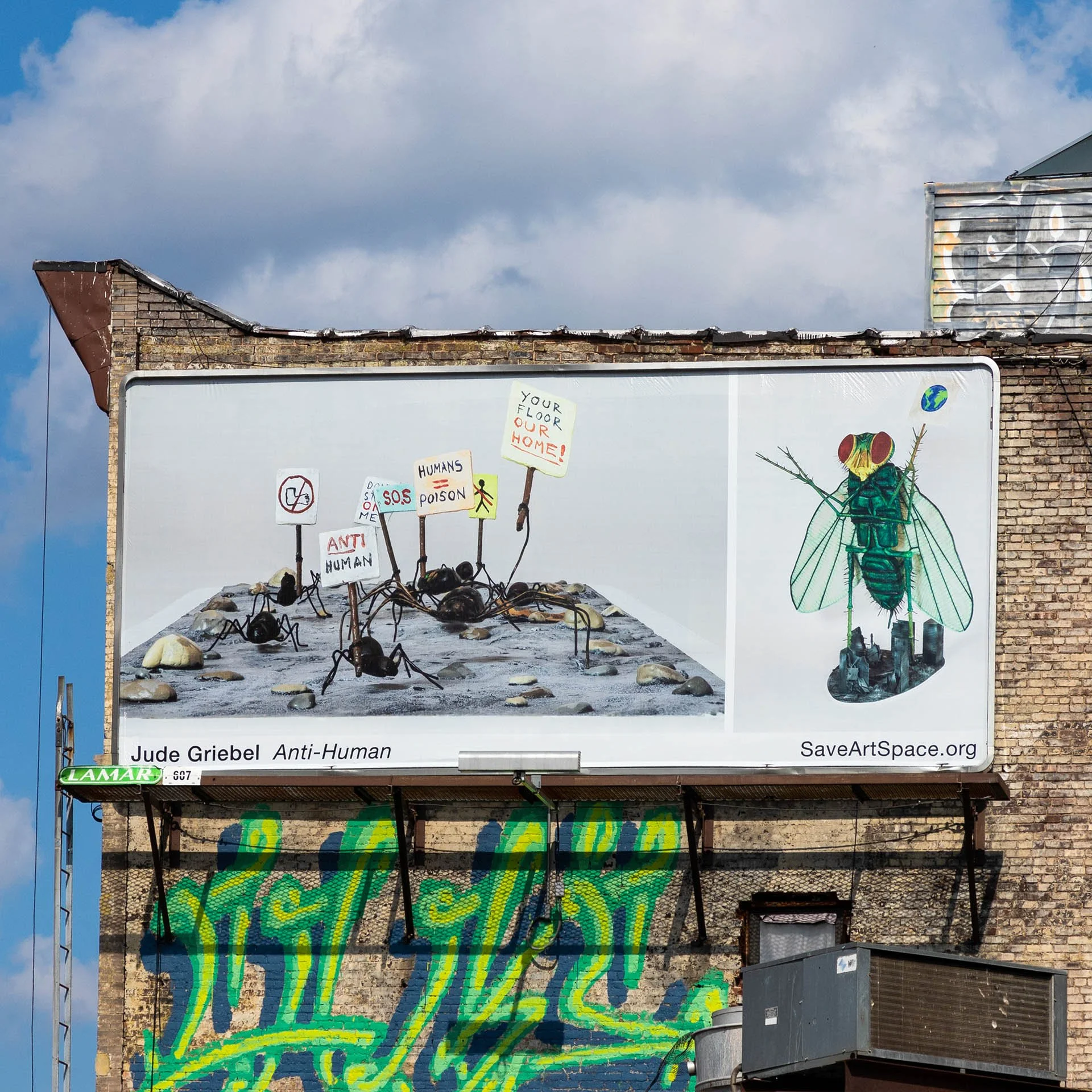
Founded in 2015, SaveArtSpace is a non-profit organization that works to create an urban gallery experience, launching exhibitions that address intersectional themes and foster a message of social change that benefits the working class. By placing culture over commercialism, SaveArtSpace aims to empower artists from all walks of life and inspire a new generation of young creatives and activists.