
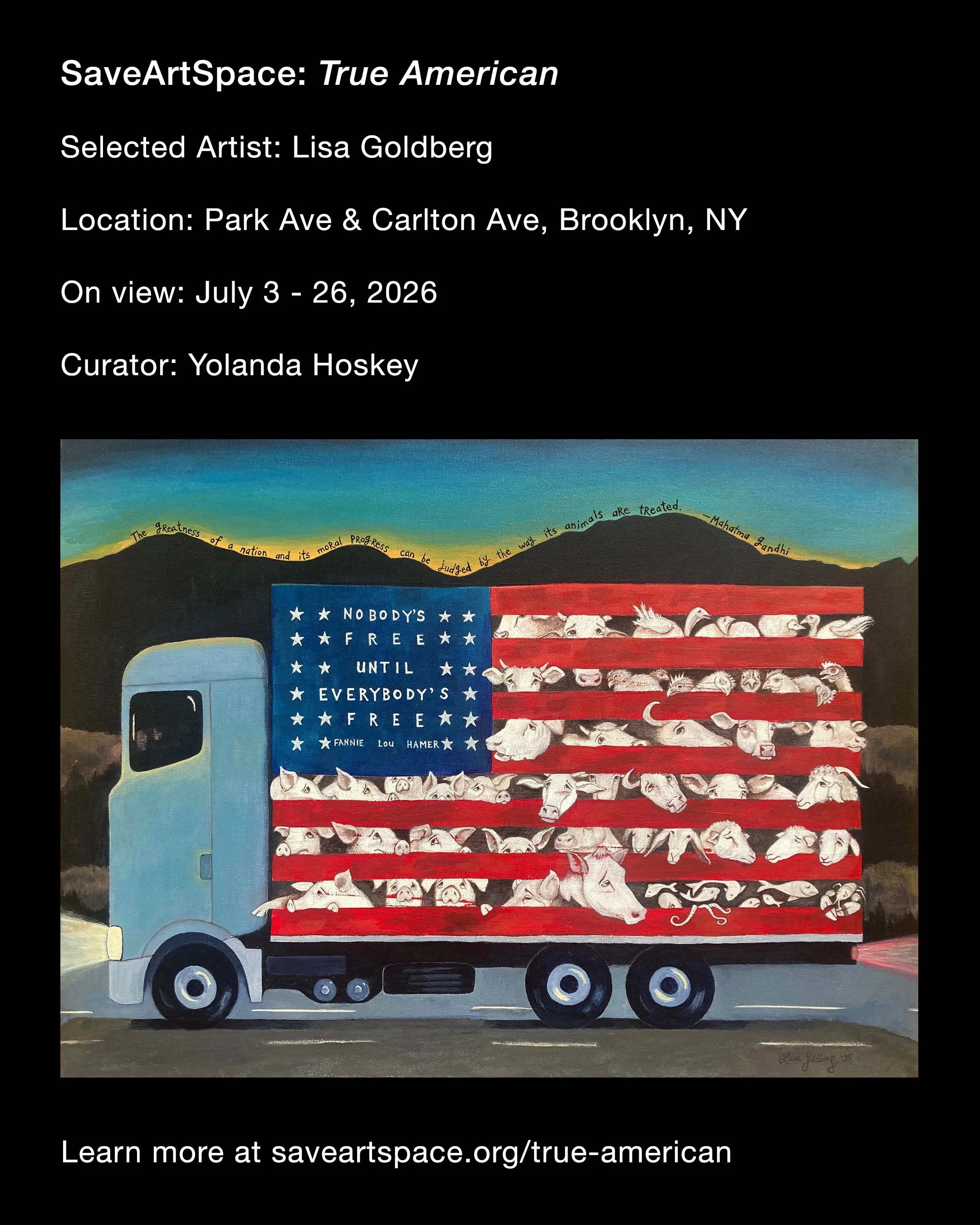
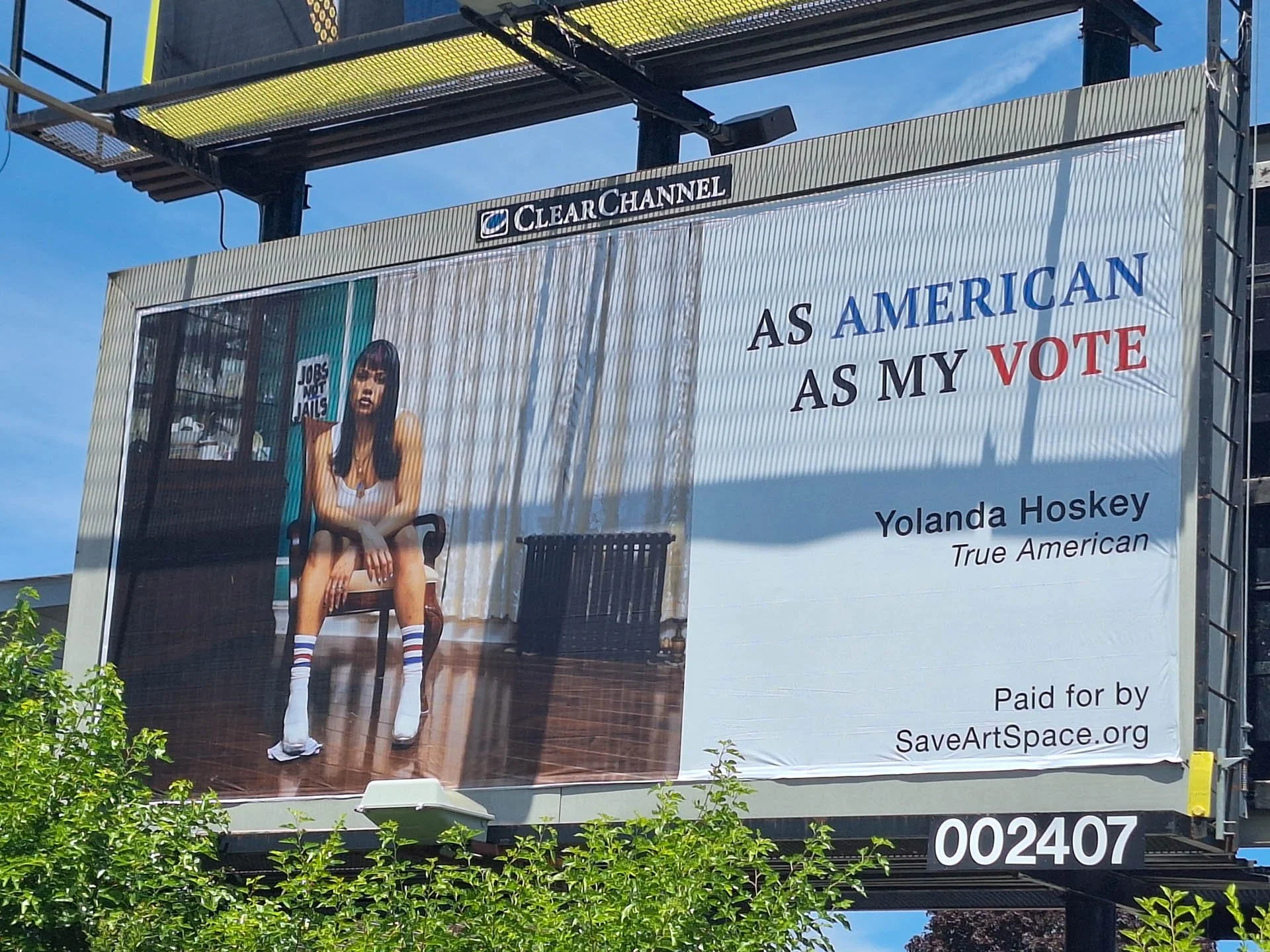
SaveArtSpace is proud to present True American, a public art exhibition on billboard ad space in New York, NY, opening July 3, 2026, curated by Yolanda Hoskey.
The True American selected artist is Lisa Goldberg.
This billboard exhibition considers America not as a finished idea, but as an ongoing and unresolved project. As the nation approaches its 250th year, the work brings together artists who examine the distance between national ideals and lived realities.
Taking inspiration from a long tradition of Black critique that questions who America is truly for, this exhibition invites artists to confront, challenge, and make visible the conditions of life within the nation as it exists today.
Rather than celebrating a fixed narrative, the exhibition creates space for reflection, contradiction, and truth—centering voices and experiences that have historically been excluded from dominant representations of American identity. Artists are invited to submit work that interrogates, redefines, or reflects on the realities of living in America today. Submissions may engage with themes of identity, citizenship, belonging, exclusion, freedom, and contradiction.
What does America look like in practice?
Who does it serve—and who does it fail?
Opening July 3, 2026, SaveArtSpace will launch a public art installation for the selected artwork on billboard ad space in New York, NY. The public art will be on view for at least four weeks.
Selected Artist
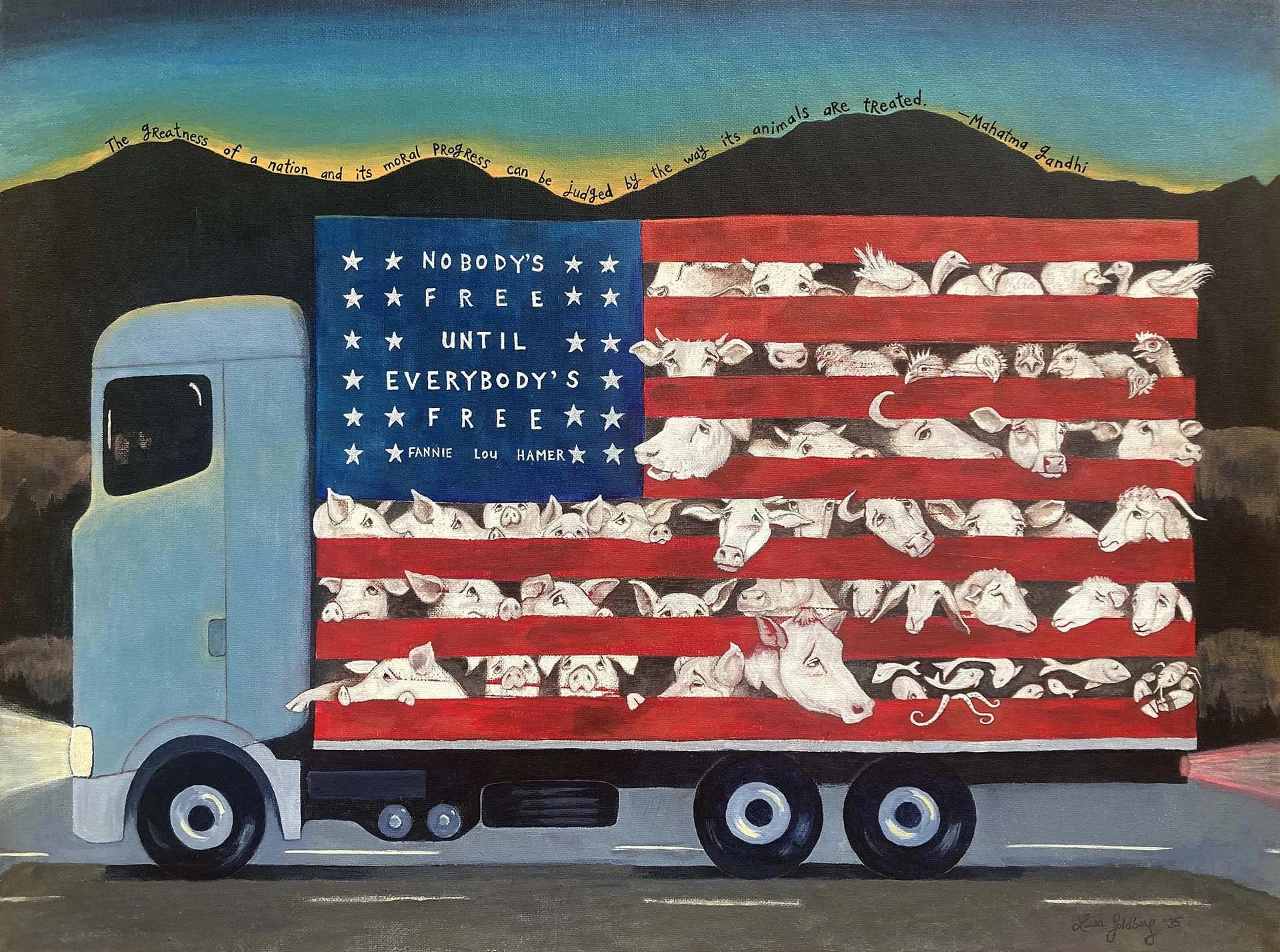
Lisa Goldberg
THE GHOSTED
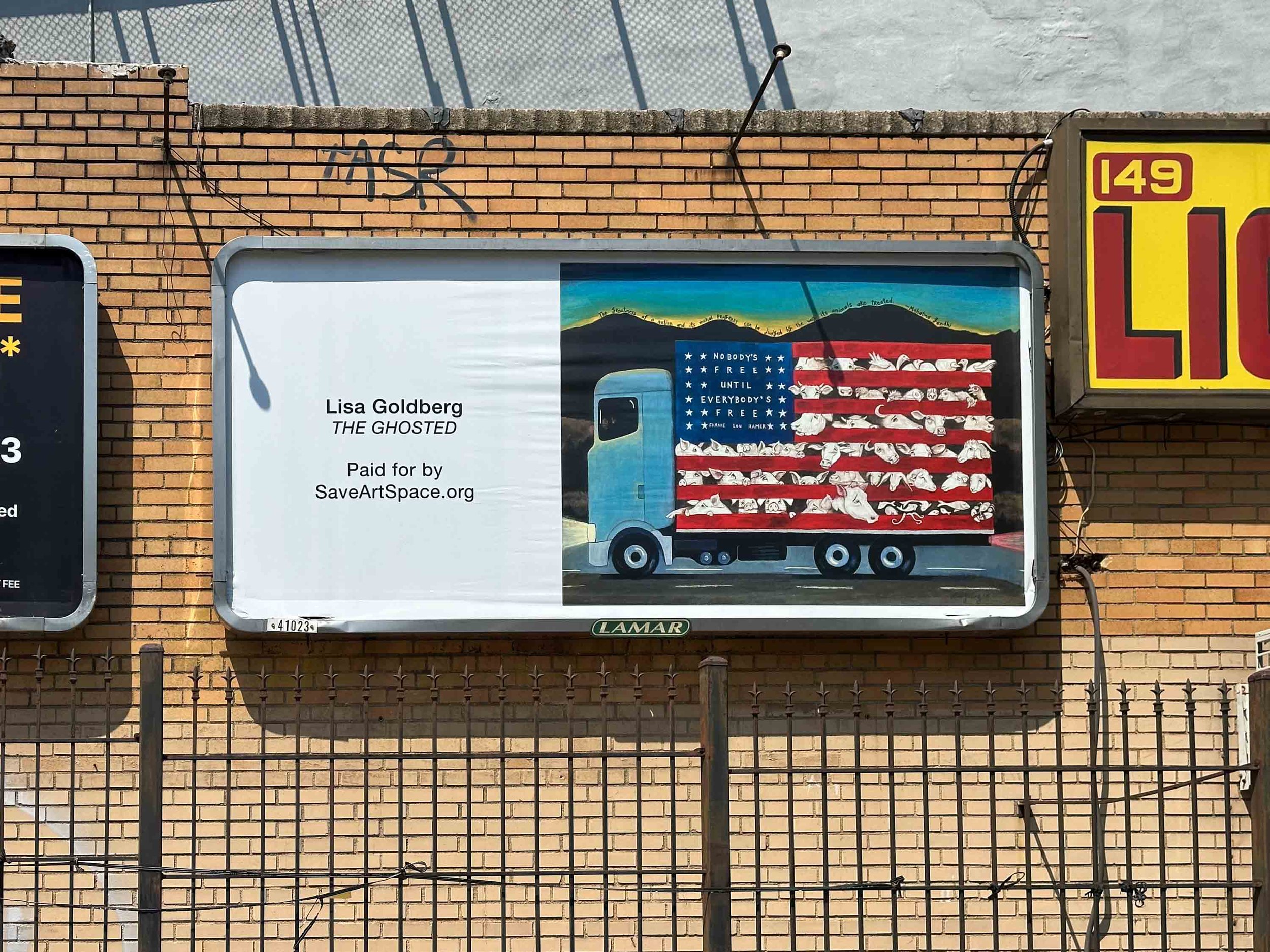
Location: Park Ave & Carlton Ave, Brooklyn, NY
Lisa Goldberg is an artist and illustrator based in New York City. Much of her work is centered on raising awareness of the massive harms caused by our system of capitalist animal agriculture.
Amid the oppression of so many groups in the U.S. (and around the world), nonhuman animals are surely the most oppressed of all. In the U.S. alone, we violently kill billions of land animals and trillions of sea animals each and every year for food. Before enduring the pain and terror of slaughter, 97-99% of the land animals we consume, along with billions of sea animals, spend their entire lives in factory “farms” where they suffer horrific abuse and are deprived of everything that would make their lives worth living. Yet, most of us don’t consider this to be a problem, or indeed consider it very much at all.
How is it that so many of us claim to “love animals,” yet support their cruel treatment by sitting down three times a day to consume their flesh, milk, and eggs?
As extreme as the cruel treatment of farmed animals is, they aren’t the only ones who suffer in our broken animal industrial complex. This is a system built on quick profits at any cost, in which both animals and also human laborers are treated as commodities.
Typically, only the most vulnerable workers – those without other options – wind up working in factory farms and slaughterhouses. These include immigrants, refugees, and undocumented workers, who labor in these low paying jobs that are among the most physically dangerous and psychologically damaging. Workers are forced to operate heavy machinery at frantic line speeds, putting them at high risk of catastrophic injuries. They must perform or witness the mass slaughter of animals on a daily basis, often leaving them with severe PTSD.
I’ve titled my painting THE GHOSTED, both in memory of the animals who have suffered and died for human consumption, and also because of the way we’ve severed contact with – or “ghosted” – farmed animals and the human beings trapped in the jobs of raising and killing them. We hide these living, feeling individuals out of sight and earshot of most consumers, and in doing so we manage to remain blissfully ignorant of their profound suffering.
Paul McCartney famously said, “If slaughterhouses had glass walls, everyone would be vegetarian.” Today there is a huge amount of undercover film footage from inside both slaughterhouses and factory farms. This footage is available online with the click of a keypad – essentially turning the walls to glass for anyone willing to look. We do though have to be willing to look, and most people are not. Most say it’s too graphic, too disturbing, to see the inherent cruelty in how we obtain not only the flesh, but also the milk and eggs of farmed animals. If it is too disturbing though for us to even to witness their suffering, how can we allow these animals and workers to live through it? How can we go on supporting it with our pocketbooks - every day, with every meal?
Connect with Lisa at @lisamollie2.
Curator
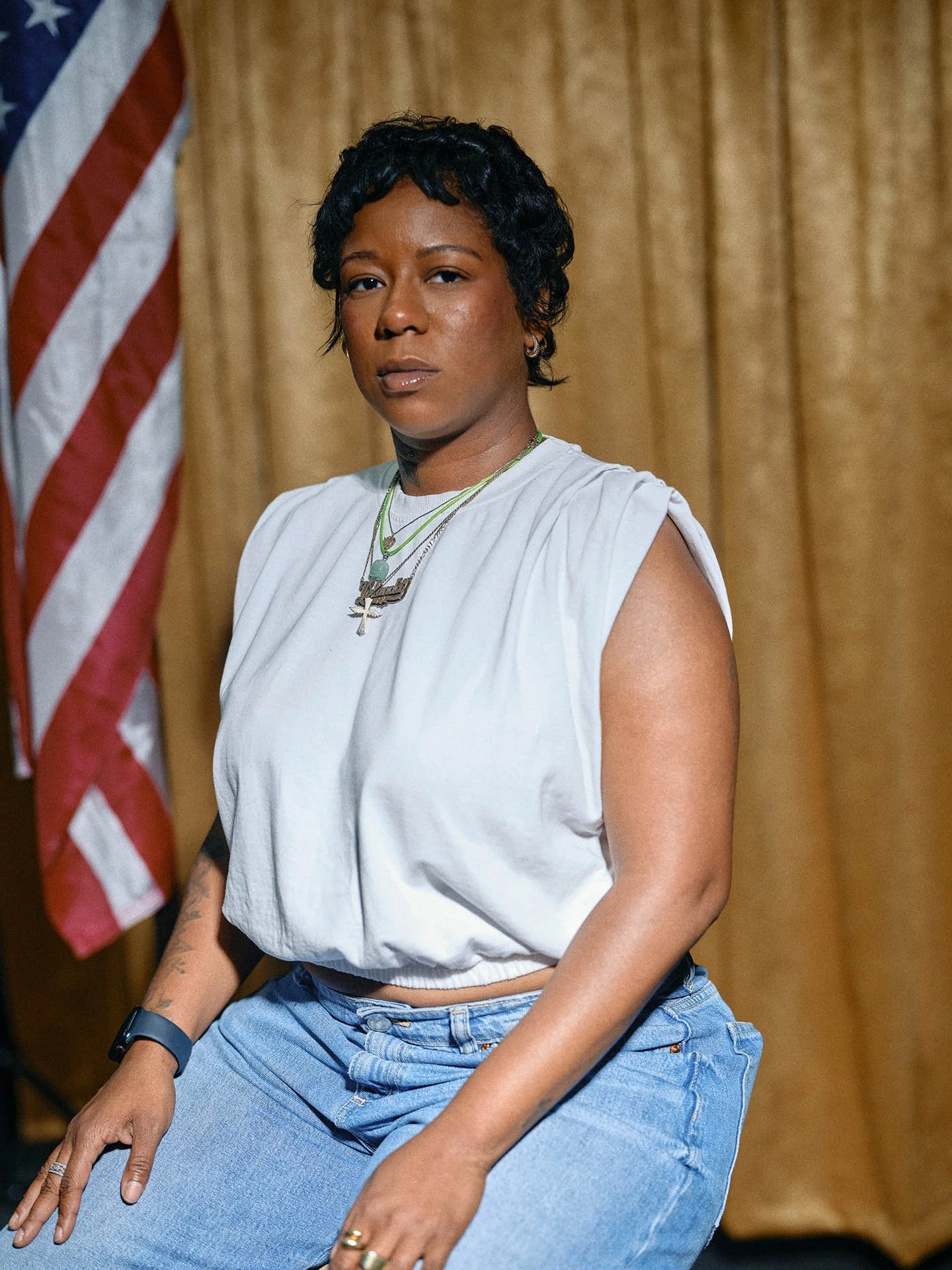
Yolanda Hoskey is a multidisciplinary artist based in Brooklyn, New York. Working across photography, film, and visual storytelling, her practice explores the complexities of Black identity and the contradictions of American life. Her work centers presence, intimacy, and narrative as tools for expanding how Black experiences are seen and understood. Through both her artistic and curatorial work, she is interested in how images shape public perception, memory, and cultural narratives.
She is a 2024 Magnum Foundation Fellow, a 2025–26 BRIC Lab Artist-in-Residence, and a 2025 recipient of the International Photographic Council Rising Star Award, presented at the United Nations.
Connect with Yolanda at @ghettoyolie.
SaveArtSpace
Founded in 2015, SaveArtSpace is a non-profit organization that works to create an urban gallery experience, launching exhibitions that address intersectional themes and foster a message of social change that benefits the working class. By placing culture over commercialism, SaveArtSpace aims to empower artists from all walks of life and inspire a new generation of young creatives and activists.